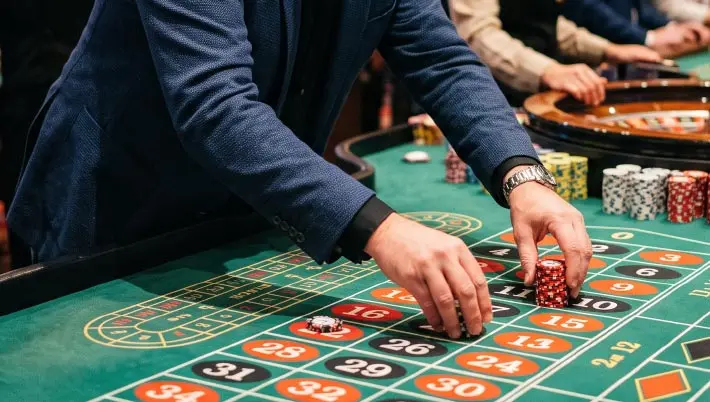
Even casino newcomers are aware that the math is always stacked in favor of the casino when you play real money casino games. That bias is called the "house edge." The house edge is the unspoken percentage of your wagers that the casino counts on holding in order to continue to do business.
But there's a secret that few people know -- while you can’t make the house edge disappear entirely, you can wear it down a bit. By mastering game selection, exploiting rule quirks, and playing with proven strategy, you can shrink the casino's built-in advantage to a fraction of what the casino expects.
Check out the Grande Vegas gambler’s playbook for how to beat the house edge where you learn how to stop relying on luck and start playing on your own terms.
What is the House Edge?
The golden rule of gambling is that the House Always Wins. There is, however, a caveat. The house only wins when players don’t know what they’re doing. The moment you trade gut feelings for raw mathematics, the casino’s house edge begins to crumble. How can you impact the house edge in your favor?
The casino house edge is the built-in mathematical advantage that a casino holds over players in any given game. It is expressed as the percentage of your total bets that the casino expects to keep as profit over the long run.
For example, if a game has a 5% house edge, it means that for every $100 you wager, the casino expects to keep $5 as profit with $95 returned as winnings. The casino doesn't rig games to attain the house edge – the advantage is a part of the game through paying less than the true odds and positional rules.
- "Paying less than true odds" refers to the casino payouts that come at a lower ratio than the actual probability of winning. For instance, on an American roulette wheel there are 38 pockets (numbers 1 to 36, plus 0 and 00) so the true mathematical odds of hitting a single number are 37 to 1. However, the casino only pays out 35 to 1 on a winning single number bet because the green 0 and 00 pockets create a 5.26% house edge.
- The "positional rules" force the player to act and make decisions before the dealer does. For example, in blackjack, if your hand total exceeds 21, you "bust" and lose your bet. That means that even if the dealer busts later in the same round, you lost because you went first.
Long Run vs. Short Run
If you look at the house edge of a game and assume that every gaming session will follow that percentage, you would be mistaken. The house edge is a long-term statistical average. That means that, over the long term, you will lose $5 after you've bet $100 but in the short term, you can't rely on that figure.
In the short term, anything can happen. Due to statistical variance (luck) you might double your money. Or you might lose it all. Or you might meet the stated house edge. This short-term volatility is what makes gambling exciting.
In the long term, lucky streaks even out and the actual payout percentage of the game will come to align with the mathematical house edge.
House Edge by Game
Different games carry drastically different advantages for the house. As you're planning on a gaming session where the house edge is as low as possible, you'll need to choose your game accordingly.
|
Game |
House Edge |
Player Impact Strategy |
|
Blackjack Vegas Rules |
~0.5% |
Very low house edge if you play using Perfect Basic Blackjack Strategy |
|
Baccarat Banker Bet |
1.06% |
Achieved by placing your bet on the Banker and letting the dealer play it out. |
|
Craps Pass / Don't Pass |
~1.4% |
Achievable by sticking to simple line bets and avoiding proposition bets |
|
European Roulette Single Zero |
2.70% |
Most desirable form of roulette for a low house edge |
|
American Roulette Double Zero |
5.26% |
High house edge – avoid roulette variations with 00 or 000 pockets |
|
Slots Online and Land-Based |
~4-5% (online) ~10-20% (land-based) |
House edge varies widely -- determined by the software's preset Return to Player (RTP). |
|
Keno |
20.0% – 25.0% |
Terrible Odds. To be avoided if your goal is to preserve a bankroll |
Strategies for Achieving the Best House Edge in Blackjack
Blackjack offers the best house edge at the casino but that number is conditional, assuming you make the mathematically perfect move on every single hand. That means that you should avoid 6:5 payouts which drastically increase the edge, look for variations where the dealer stands on a soft 17, and play with as few decks as possible.
Some of the other tactics that you can adopt to minimize the house edge in blackjack is to always split Aces and 8s but never split 5s or 10s and double down if you have a strong starting hand and the dealer is showing a weak upcard.
It's suggested that you never take insurance and skip all side bets like the Perfect Pairs side bet.
Strategies for Achieving the Best House Edge in Baccarat
In baccarat, the rules dictate exactly how the cards are dealt. Players have no control over hitting or standing. Therefore, reducing the house edge in baccarat comes down to bet selection and avoiding high-edge traps.
The first basic rule to keep the house edge as low as possible when playing baccarat is to stick to the math. In baccarat, there are 3 standard bets, the banker bet, the player bet and the tie bet. The banker bet is statistically the smartest wager on the table. Even with the commission, it holds the lowest house edge – just beware that there's a 5% commission that you pay to the casino on all Banker Bet wins.
The player bet's house edge is a bit higher but still an acceptable alternative. The tie bet has the highest house edge – 9.5% -- and should be avoided completely.
Secondly, if you can find a commission-free baccarat table, you can avoid the 5% commission fee when the Banker bet wins but the bet pays out at a lower rate (instead of the standard 1:1, it's a 2:1 payout) which inflates the Banker house edge from 1.06% up to 1.46%. It's best to avoid commission-free tables in favor of traditional baccarat tables.
Finally, be careful of the pace of a baccarat game. Baccarat moves at a fast pace which can drain your bankroll quickly due to the sheer volume of gameplay. To balance this fast pace, slow down your gameplay. Sit out spins and minimize your total hourly wagers to insulate your bankroll.
Strategies for Achieving the Best House Edge in Slots
Unlike skill-based casino games like Blackjack, slot machines run entirely on Random Number Generators (RNG) and have a mathematical house edge that cannot be overcome in the long run.
However, there are strategies that you can use to maximize your odds and achieve the absolute lowest possible house edge.
- Look for the highest RTP (Return to Player) percentage. The RTP is the inverse of the house edge – if the house edge for a specific slot is 4%, the RTP would be 96%. Look for the game's RTP in the game's information packet.
- Consider the slot machine's volatility as it impacts on your bankroll. A game's volatility doesn't change the house edge but it dictates how you win. If you're playing a low volatility game, you can expect smaller and more frequent wins. Low volatility games are good games for players who want to clear a casino bonus or wish to experience a longer, steadier session with a smaller bankroll. The high volatility games feature less frequent, but bigger, wins. High volatility games a high-risk games that require a larger bankroll that will allow you to survive long, dry spells.
- Some slot machines feature a progressive jackpot prize but choosing a progressive jackpot game requires a deeper understanding of the math involved. In a progressive jackpot game, a portion of every bet is put aside into the jackpot pool, which will increase as more players play the game but will be won by only the one player who hits the jackpot trigger. Progressives are a trap for house-edge optimization. Since so much of the payout is based on the jackpot win, the RTP on the machine's base game is quite low – sometimes 89% or even less. So consider whether you want to play cautiously or experience a risky slots session with the possibility that you could be the one to hit the jackpot prize!
- Leverage the Bonus Buy Feature. In some 2026 slots, you can bypass the base game grind by buying the bonus round directly. On the one hand, in some slot machines, the theoretical RTP actually increases during bought features. However, buying a Bonus makes the volatility spike so your bankroll can drain quickly if the purchased bonus doesn't perform as expected.
- Maximize your paylines and bets. On some older machines, you can place different value bets on different paylines. This drops the slot's effective RTP and creates situations where, if you haven't placed a bet on a line, your win won't pay out. To maximize your bankroll, lower your wagers but bet on all available paylines so you achieve payouts on any wins.
Online or In-Person?
Do strategies for lowering the house edge differ if you're gambling online or playing in-person?
Yes, they are quite different. It's true that the core mathematical strategies of the games themselves remain identical but when you play online, you fight the house edge in a different way.
Playing online gives you access to a different set of tools and rules. If you're playing online, here are some of the things that you can do to boost your advantage:
- Exploit the EV – The Expected Value of a gaming session increases thanks to the deposit matches, free spins, and cashback deals found at the online casino. If you do the math right, these bonuses can temporarily turn the house edge into a player edge. Even when you need to clear a bonus or bet at a certain level, utilizing the bonus gives you more chances to beat the house edge for that session.
- Check the RTP of the game and choose your games accordingly. Land-based casinos don't publicize their payout settings but when you're playing online, you can check the game's stats in the game's Help Menu or at the game developer's site and avoid low RTP games.
- Control the pace of the game. When you're playing in-person, you must play at the speed of the dealer and other players at your table. When you're playing online, you control the pace. You can take your time to reference strategy charts or speed up your play at your leisure. If you speed things up, remember that faster play exposes your bankroll to the house edge more rapidly.
Responsible Gaming
The most important strategy for gambling success is understanding the relationship between the house edge and responsible gaming. Understanding the house edge will guide you as you manage your expectations and protect your financial well-being.
Start by understanding that gambling is a form of entertainment, not a source of income. Every casino game has a negative mathematical expectation so the longer you play, the closer your results will get to that built-in house advantage.
Accept that the house edge ensures the casino will always win in the long run so that you don't view wins as a given. Wins must be seen as temporary, lucky anomalies that enhance the entertainment experience.
FAQs
1. Can you eliminate the casino's edge?
Yes, but it is incredibly difficult. You can:
- Count cards in blackjack (track the ratio of high cards to low cards left in the shoe to identify when the remaining cards will favor the player. Then, you can bet accordingly (works only at a land-based casino since the cards are shuffled constantly in online blackjack games)
- Play Double Double Bonus video poker where the RTP is 100.1% if you play exactly according to poker strategy.
- Hunt low-bet bonuses whose wagering requirements you can fulfilled with high RTP slots
2. Do betting systems like the Martingale reduce the house edge?
Absolutely not. The Martingale system (doubling your bet after every loss) is a psychological trap, not a mathematical strategy. While it feels like you will eventually win back your losses, betting systems do not change the odds of any individual spin or hand. The house edge remains exactly the same. If you hit a losing streak, your entire bankroll can be quickly cleaned out.
3. What is the single biggest mistake players make that inflates the house edge?
Neglecting to check the payout rules can create a situation in which you face a significantly higher house edge in blackjack. If you play a 6:5 Blackjack instead of 3:2 Blackjack, the house edge climbs from 0.5% up to 2.0%, and wipes out any advantage you gain from playing perfect basic strategy.
4. If a game has a low house edge, does that mean I am guaranteed to win in the short term?
No. A low house edge simply means your bankroll will stretch further over time. In any short session, luck dominates.